

Understanding Detected Patterns
When you open a case, PraxPilot displays a Detected Patterns panel inside the Clinical Insight section.
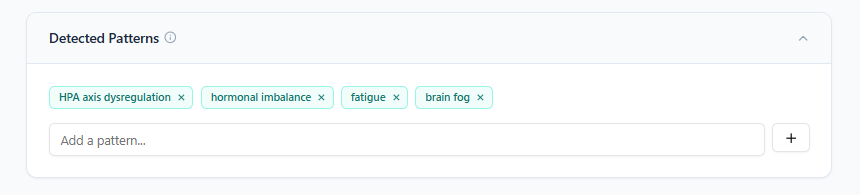
What Detected Patterns Are
Detected Patterns are clinical themes extracted from the case data. They describe what is happening in the patient's presentation.
Examples of detected patterns:
Digestive dysfunction
Metabolic / blood sugar pattern
Hormonal imbalance
Inflammatory pattern
Stress and adrenal strain
What They Are Used For
Detected patterns serve two purposes:
They help you quickly identify the dominant clinical themes in a case.
They inform the Clinical Reasoning Engine when structuring the protocol.
Detected Patterns vs. Root Cause Intelligence
Detected Patterns identify what is present in the case. Root Cause Intelligence goes one step further and suggests what might be driving those patterns. See Article 19 for a full explanation.
Smart Follow-Up Questions
In some cases, PraxPilot suggests additional questions to help refine a detected pattern.
These appear under a pattern as:
“To refine this pattern:”
Example:
Sleep disruption or night waking?
Energy patterns throughout the day?
Menstrual cycle regularity changes?
Why this matters
These prompts help you:
Validate whether a pattern is clinically relevant
Reduce uncertainty before finalizing a protocol
Ensure your recommendations are well-supported
Important
These are optional prompts designed to support your thinking.
PraxPilot assists your clinical reasoning — it does not replace your judgment.